If you're reading this while a toddler hides behind the couch to fill a diaper, I see you. Potty training can feel like it comes with a deadline: the preschool that wants kids trained by three, the relative who swears you were done at eighteen months, the friend whose daughter learned in a weekend. That's a lot of pressure on something that mostly depends on a little body and brain getting ready on their own schedule.
Here's the good news. The research is reassuring, and it points toward a calmer way to do this.
Most kids are ready later than you think
In a study of 267 children published in Pediatrics, the median age for staying dry during the day was about 32 months for girls and 35 months for boys. That's closer to three than two. Even showing interest in the potty, one of the earliest signs, came at around 24 months for girls and 26 months for boys. The researchers concluded that most children don't master the readiness skills until after their second birthday.
So if your two-year-old couldn't care less about the potty, nothing is wrong. That's what most two-year-olds are like.
Signs your child may be ready:
- Staying dry for a couple of hours, or waking up dry from naps.
- Noticing when they're peeing or pooping, with words or that unmistakable look.
- Curiosity about the toilet, or wanting to copy you or an older sibling.
- Pulling pants up and down, and following simple two-step directions.
- Not liking a wet or dirty diaper.
Why starting early can backfire
A 2003 study in Pediatrics followed about 380 children from the age of 17 to 19 months. Starting intensive training (asking a child to try the potty more than three times a day) before 27 months did not mean finishing earlier. It mostly meant training took longer. The study's lead author told HealthDay that children who started before 27 months often took a year or more, while those who started between 27 and 36 months took about five to ten months.
If you started early, please don't panic. In that study, early starters didn't have more constipation or withholding. It may simply be a longer road, and it's fine to pause and try again in a few months.
A gentle way to do it
- Pick a calm stretch. Not the week a new sibling arrives, you move, or you're traveling for the holidays.
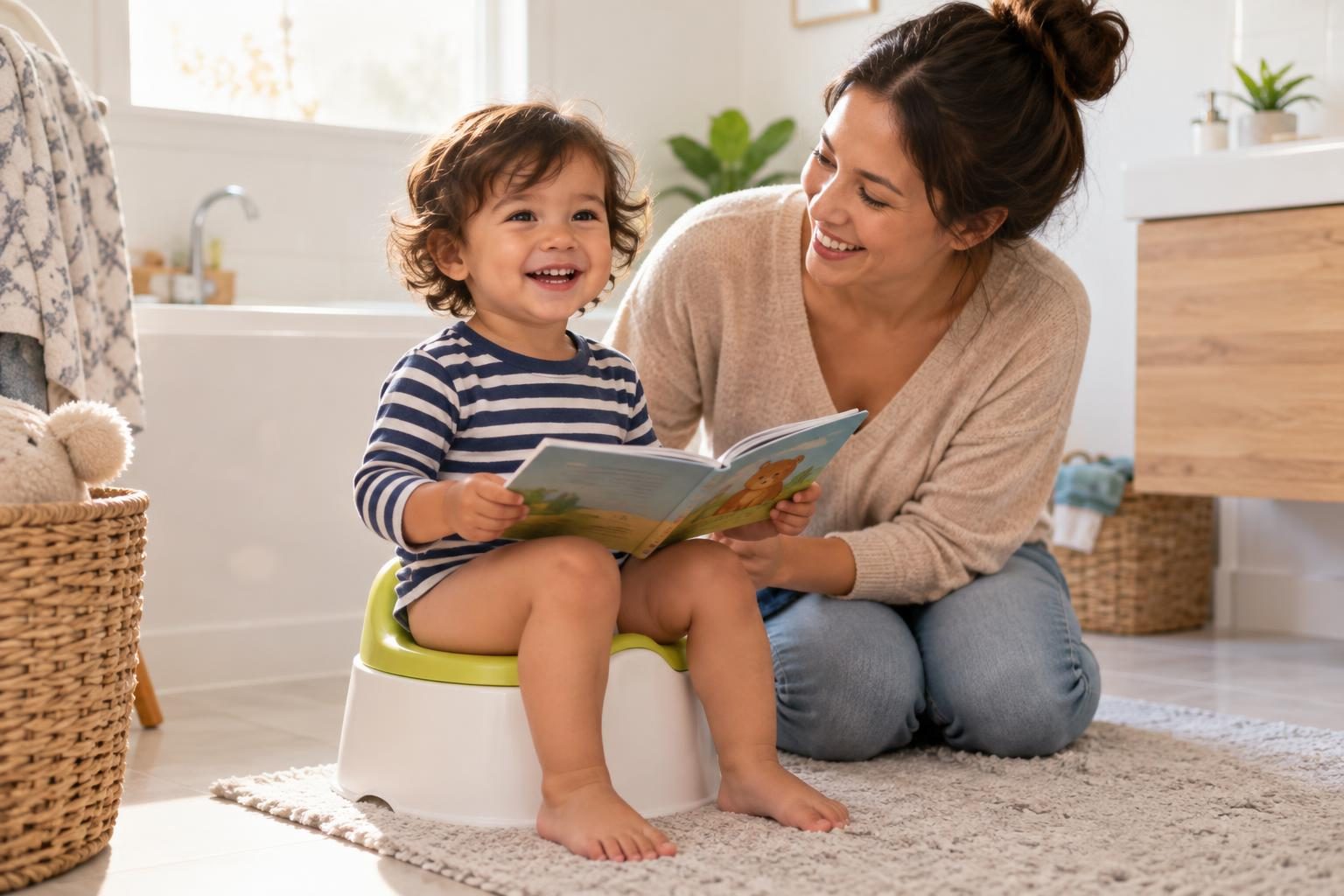
- Let them practice first. Put a little potty in the bathroom, let them sit on it clothed, and read a book about it together.
- Offer, don't insist. Try after waking up, after meals, and before bath or the car, and keep it light if they say no.
- Dress for success. Easy pull-down pants help, and many families start with a few bare-bottom days at home.
- Celebrate tries, not just wins. Stickers and a silly potty dance are great. Shame and punishment tend to backfire, because a worried child is more likely to hold it in.
- Expect accidents. Lots of them, for weeks. Keep a change of clothes everywhere and your voice calm.
Poop, nights and setbacks
Many kids pee in the potty well before they're comfortable pooping there. If your child starts holding poop in, or gets constipated, take the pressure off and talk to your pediatrician. Comfort comes first.
Nights are a separate milestone. Staying dry overnight depends on body maturity, not effort. The American Academy of Child and Adolescent Psychiatry estimates that about 20% of five-year-olds and 10% of seven-year-olds still wet the bed, and most outgrow it on their own. Night diapers or pull-ups are not a failure.
Setbacks are normal too, especially around big changes: a new baby, a new school, an illness, a trip. Go back to the basics, stay calm, and it usually passes.
When to call your pediatrician
- Pain or crying when peeing or pooping, or blood in either.
- Hard, painful poops or holding it in that lasts more than a few days.
- A child who was reliably dry and suddenly has lots of accidents.
- No interest at all by around age four, or anything that just doesn't feel right to you.
The part nobody says out loud
Every child gets there. The kid who trained at two and the kid who trained at almost four will both walk into kindergarten in underwear, and nobody will ever ask which one was first. Your worth as a parent isn't measured in dry pants. Follow your child's lead, protect your relationship, and let this be one more thing you figure out together.
This is general information from one parent to another, not medical advice. Your pediatrician knows your child best, so check in with them about anything that worries you.
Sources
- Schum et al. Sequential acquisition of toilet-training skills: a descriptive study of gender and age differences in normal children. Pediatrics, 2002.
- Blum, Taubman & Nemeth. Relationship between age at initiation of toilet training and duration of training: a prospective study. Pediatrics, 2003.
- HealthDay. Toilet training goes faster if time is right (interview with the study's lead author).
- American Academy of Child and Adolescent Psychiatry. Bedwetting (Facts for Families).
- American Family Physician. Toilet training (review), 2008.